Sri Samanvi Hospital & Fertility Centre
Gandhipuram, Rajamahendravaram, Andhra Pradesh – 533103
Meet Our Fertility Specialists
Dr. Sowjanya M.
M.S. (OBGY), Fellowship in Reproductive Medicine, FMAS
Dr. B.M. Rayudu
M.D. (Radiodiagnosis)
What Is ICSI?
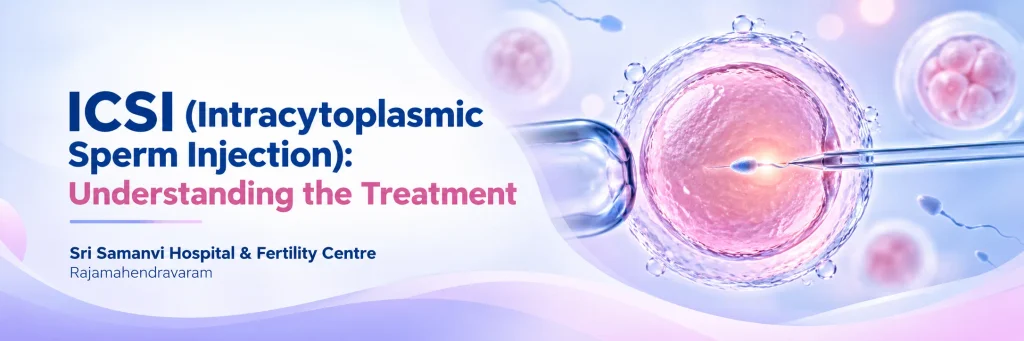
ICSI (Intracytoplasmic Sperm Injection) is a specialized fertility treatment technique used as part of an IVF treatment cycle.
In ICSI, a single selected sperm is carefully injected directly into a mature egg in the laboratory to assist fertilization. Unlike conventional IVF, where sperm and eggs are placed together in a laboratory dish, ICSI involves directly injecting the sperm into the egg.
ICSI may be considered particularly when there are certain sperm-related problems or when fertilization has been unsuccessful or very limited in a previous IVF cycle.
How Does ICSI Treatment Work?
ICSI is generally performed as part of an IVF cycle. The treatment involves several stages.
1. Ovarian Stimulation
Fertility medications may be given to stimulate the ovaries so that multiple eggs can develop.
2. Follicle Monitoring
The development of follicles and eggs is monitored using ultrasound scans and, when required, blood tests.
3. Egg Retrieval
When the eggs are considered mature, they are collected through an egg retrieval procedure.
4. Sperm Collection
A sperm sample is collected from the male partner. In selected cases where sperm cannot be obtained normally from semen, sperm-retrieval procedures may be considered.
5. Sperm Selection
In the laboratory, an individual sperm is selected for injection into a mature egg.
6. Sperm Injection
Using specialized laboratory equipment, the selected sperm is carefully injected directly into the egg.
7. Fertilization and Embryo Development
The eggs are observed to determine whether fertilization occurs. Fertilized eggs may continue developing into embryos in the laboratory.
8. Embryo Transfer
If an embryo is considered suitable for transfer, it may be transferred into the uterus as part of the IVF treatment process.
Who May Benefit From ICSI?
ICSI may be considered for couples experiencing certain fertility problems, particularly when there may be difficulty with fertilization.
It may be recommended in situations such as:
- Very low sperm count
- Poor sperm motility
- Abnormal sperm morphology
- Certain severe male-factor infertility conditions
- Previous IVF cycle with very low or no fertilization
- Certain cases where sperm has been surgically retrieved
- Some conditions where sperm cannot reach the semen normally
- Selected cases of unexplained fertilization problems
The decision to use ICSI should be based on an individual fertility evaluation.
ICSI for Male Infertility
Male-factor infertility can occur because of problems with sperm count, movement, shape or sperm availability.
One of the important features of ICSI is that the procedure uses an individual sperm and directly injects it into a mature egg.
Therefore, ICSI may be considered for certain couples where conventional fertilization may be difficult because of significant sperm-related factors.
However, the appropriate treatment depends on the underlying cause of infertility and the results of the couple’s fertility evaluation.
ICSI After Previous IVF Failure
Sometimes an IVF cycle may result in little or no fertilization even when mature eggs and sperm are available.
In such cases, a fertility specialist may consider ICSI in a subsequent treatment cycle.
By directly injecting a selected sperm into a mature egg, ICSI can help overcome certain problems associated with the fertilization process.
However, ICSI does not guarantee pregnancy or a successful birth. Fertilization is only one stage of the overall fertility treatment journey.
ICSI vs IVF: What Is the Difference?
ICSI is actually a specialized fertilization technique used during an IVF cycle.
| Conventional IVF | ICSI |
|---|---|
| Eggs and sperm are placed together in the laboratory | A single sperm is injected directly into a mature egg |
| Fertilization occurs without direct sperm injection | Fertilization is assisted through sperm injection |
| May be suitable when sperm is expected to fertilize normally | May be considered when fertilization problems are more likely |
| Does not require direct injection of sperm into the egg | Requires specialized laboratory equipment |
The choice between conventional IVF and ICSI depends on the individual fertility assessment and treatment history.
Is ICSI Suitable for Everyone?
No.
ICSI is not automatically required for every person undergoing IVF.
A fertility specialist may consider factors such as:
- Sperm count and quality
- Previous fertility treatment
- Previous fertilization results
- Egg quality and maturity
- Age and reproductive history
- Cause of infertility
- Previous IVF or ICSI outcomes
After evaluating these factors, the fertility team can discuss whether conventional IVF or ICSI may be appropriate.
What Tests May Be Done Before ICSI?
Before starting ICSI, fertility specialists may recommend tests for both partners.
For the Male Partner
Depending on the situation, evaluation may include:
- Semen analysis
- Sperm count assessment
- Sperm motility assessment
- Sperm morphology assessment
- Hormonal tests when required
- Additional investigations for severe sperm abnormalities
- Genetic evaluation in selected cases
For the Female Partner
The fertility evaluation may include:
- Ovarian reserve assessment
- Hormonal tests
- Ultrasound examination
- Evaluation of the uterus
- Assessment of reproductive history
- Other fertility tests based on individual needs
The exact tests required can vary from couple to couple.
What Are the Possible Risks or Limitations of ICSI?
Like any fertility treatment, ICSI has certain limitations.
These may include:
- Not every egg will be mature enough for injection.
- An egg can occasionally be damaged during the injection procedure.
- Fertilization may still not occur in every injected egg.
- Not every fertilized egg will develop into an embryo.
- Not every embryo will result in pregnancy.
- Certain underlying causes of male infertility may have genetic implications.
Your fertility specialist can explain the potential benefits and limitations based on your individual circumstances.
Does ICSI Guarantee Pregnancy?
No. ICSI does not guarantee pregnancy.
ICSI is primarily a technique used to assist the fertilization process.
Even when fertilization occurs, several other stages are involved before a successful pregnancy can occur, including embryo development and implantation.
Treatment outcomes can vary depending on several individual factors.
ICSI vs IUI
ICSI and IUI are two different fertility treatments.
IUI – Intrauterine Insemination
In IUI, prepared sperm is placed directly into the uterus around the time of ovulation.
ICSI – Intracytoplasmic Sperm Injection
In ICSI, a single sperm is injected directly into a mature egg in the laboratory as part of an IVF cycle.
Therefore, IUI and ICSI are not the same treatment. The appropriate option depends on the cause of infertility and the couple’s fertility assessment.
ICSI Treatment at Sri Samanvi Hospital & Fertility Centre
At Sri Samanvi Hospital & Fertility Centre, Rajamahendravaram, fertility care begins with understanding the individual needs of each couple.
Our fertility team provides evaluation and guidance for different fertility conditions and treatment options.
Under the guidance of:
Dr. Sowjanya M.
M.S. (OBGY), Fellowship in Reproductive Medicine, FMAS
and
Dr. B.M. Rayudu
M.D. (Radiodiagnosis)
the fertility team focuses on understanding the possible causes of infertility and discussing suitable treatment approaches.
Depending on the individual case, treatment options may include IUI, IVF, ICSI and other fertility treatments.
Every fertility journey is different, so treatment is planned according to the individual’s medical needs and clinical evaluation.