
Sri Samanvi Hospital & Fertility Centre
Gandhipuram, Rajamahendravaram, Andhra Pradesh – 533103
Meet Our Fertility Specialists
Dr. Sowjanya M.
M.S. (OBGY), Fellowship in Reproductive Medicine, FMAS
Dr. B.M. Rayudu
M.D. (Radiodiagnosis)
What Are Hysteroscopy and Laparoscopy?
Hysteroscopy and laparoscopy are minimally invasive procedures that can help doctors examine and, in selected cases, treat conditions affecting the female reproductive system.
Although both procedures use a camera, they look at different areas:
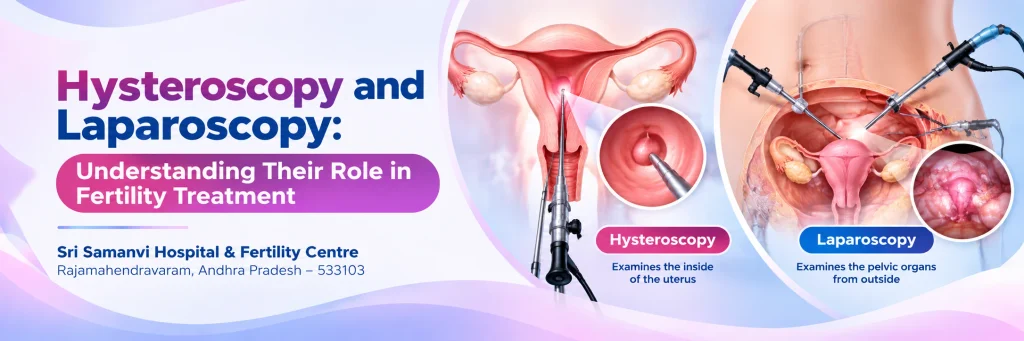
- Hysteroscopy examines the inside of the uterus.
- Laparoscopy examines the pelvic organs from the outside, including the uterus, ovaries and fallopian tubes.
These procedures may be considered during fertility evaluation when a specific uterine or pelvic problem is suspected. They can be used for both diagnosis and treatment in selected cases. Reproductive Facts
What Is Hysteroscopy?
A hysteroscopy is a procedure in which a thin instrument with a small camera, called a hysteroscope, is passed through the vagina and cervix into the uterus.
This allows the doctor to directly view the uterine cavity and its lining.
Hysteroscopy may be used to investigate or treat certain conditions that can affect fertility, such as uterine polyps, some fibroids, adhesions or other abnormalities inside the uterus. nhs.uk
Why Is Hysteroscopy Done in Fertility Care?
A hysteroscopy may be recommended when a fertility specialist suspects a problem inside the uterus.
It may help identify conditions such as:
- Endometrial polyps
- Certain fibroids that project into the uterine cavity
- Scar tissue or adhesions
- Abnormalities inside the uterine cavity
- Other structural problems
In selected situations, some abnormalities can also be treated during the same procedure. nhs.uk
How Is Hysteroscopy Performed?
During hysteroscopy:
- The patient is positioned appropriately for the procedure.
- A thin hysteroscope is introduced through the vagina and cervix.
- A sterile fluid may be introduced into the uterus to improve visibility.
- A camera allows the doctor to examine the inside of the uterus.
- If an abnormality is identified, treatment may sometimes be performed during the same procedure.
The type of pain relief or anaesthesia depends on the specific procedure and individual circumstances. nhs.uk
What Is Laparoscopy?
Laparoscopy, commonly called keyhole surgery, is a minimally invasive surgical procedure used to examine the pelvic and abdominal organs.
A small camera called a laparoscope is inserted through a small incision, usually in the abdomen.
It allows the doctor to examine structures such as:
- Uterus
- Ovaries
- Fallopian tubes
- Pelvic area
- Surrounding tissues
Laparoscopy can be used for both diagnosis and treatment of selected conditions. nhs.uk
Why Is Laparoscopy Used in Fertility Treatment?
Laparoscopy may be considered when there is a specific reason to investigate the pelvis.
For example, it may be considered when there is suspicion of:
- Endometriosis
- Pelvic adhesions
- Fallopian tube problems
- Previous pelvic infection
- Certain ovarian conditions
- Pelvic pain associated with possible reproductive conditions
A dye test may also be performed during laparoscopy to assess whether the fallopian tubes are open. nhs.uk
Importantly, laparoscopy is not routinely required for every person undergoing an infertility evaluation. It is generally considered when symptoms, scans or other fertility investigations suggest a specific pelvic problem that needs further assessment. Reproductive Facts
Laparoscopy and Fallopian Tube Evaluation
Fallopian tubes play an important role in natural conception because they provide a pathway for the egg and sperm to meet.
If there is a suspected blockage or abnormality, a doctor may recommend further testing.
During a laparoscopy, a dye can be introduced through the cervix while the doctor observes whether it passes through the fallopian tubes.
This can help assess tubal openness and identify certain pelvic abnormalities. nhs.uk
Hysteroscopy vs Laparoscopy
Although they are sometimes performed together, hysteroscopy and laparoscopy have different purposes.
| Hysteroscopy | Laparoscopy |
|---|---|
| Examines the inside of the uterus | Examines the pelvic organs from outside |
| Camera passes through the vagina and cervix | Camera is inserted through a small abdominal incision |
| Focuses on the uterine cavity | Examines uterus, ovaries, tubes and pelvic area |
| Can identify polyps, some fibroids and adhesions | Can help assess endometriosis, adhesions and tubal problems |
| Selected abnormalities may be treated during the procedure | Selected pelvic conditions may be treated during surgery |
In some fertility cases, both procedures may be performed during the same surgical session when clinically appropriate. Leeds Teaching Hospitals NHS Trust
Hysteroscopy and Laparoscopy for Infertility
Infertility can have several possible causes.
Sometimes routine fertility investigations may suggest that the uterus, fallopian tubes or pelvic organs require a closer examination.
Depending on the individual situation:
Hysteroscopy may help evaluate the inside of the uterus.
Laparoscopy may help evaluate the outside of the uterus, fallopian tubes, ovaries and pelvic area.
The decision to perform either procedure should be based on the individual’s symptoms, medical history and fertility evaluation.
Can Hysteroscopy Treat Fertility Problems?
In selected cases, hysteroscopy can be both diagnostic and therapeutic.
For example, if a polyp or certain uterine abnormality is identified, it may sometimes be removed during the hysteroscopic procedure.
Treating an identified uterine abnormality may be part of fertility care when the condition is considered clinically relevant. nhs.uk
Can Laparoscopy Treat Fertility-Related Conditions?
Yes, in selected cases.
Depending on the findings, laparoscopic surgery may be used to treat conditions such as:
- Endometriosis
- Pelvic adhesions
- Certain ovarian cysts
- Selected tubal conditions
The exact treatment depends on what is found during the procedure and the individual’s fertility goals. nhs.uk
Is Hysteroscopy Painful?
The experience can vary depending on the type of hysteroscopy and the method of pain relief or anaesthesia used.
Some people may experience cramping or discomfort during or after the procedure.
After hysteroscopy, mild period-like pain and some bleeding or spotting can occur for a short period. nhs.uk
Your doctor will explain the planned procedure and pain-relief options beforehand.
Is Laparoscopy a Major Surgery?
Laparoscopy is considered minimally invasive or keyhole surgery because it uses small incisions rather than one large abdominal incision.
However, it is still a surgical procedure and is commonly performed under general anaesthesia.
Recovery varies depending on the procedure performed and whether additional treatment was carried out during surgery. nhs.uk
What Are the Possible Risks?
Like any medical procedure, hysteroscopy and laparoscopy have potential risks.
Possible Hysteroscopy Risks
These can include:
- Infection
- Bleeding
- Uterine perforation
- Discomfort or pain
- Rare complications requiring further treatment
Most hysteroscopies are completed without serious complications. nhs.uk
Possible Laparoscopy Risks
Possible risks can include:
- Infection
- Bleeding
- Injury to surrounding organs
- Anaesthesia-related complications
- Internal scarring or adhesions
- Blood-vessel or bowel injury, which are uncommon but possible
Your doctor will explain the individual risks and benefits before the procedure. Leeds Teaching Hospitals NHS Trust
Recovery After Hysteroscopy
Recovery depends on the type of hysteroscopy performed.
Some patients can return home the same day.
Mild cramping or spotting may occur after the procedure.
Your doctor will provide specific instructions regarding:
- Activity
- Medication
- Sexual activity
- Follow-up
- Warning signs that require medical attention
Recovery After Laparoscopy
Because laparoscopy is performed under anaesthesia and involves small abdominal incisions, recovery may take longer than a simple diagnostic hysteroscopy.
The recovery period depends on whether the procedure was only diagnostic or whether treatment was performed at the same time.
Your doctor will advise you when you can resume normal activities.
Can Hysteroscopy and Laparoscopy Be Done Together?
Yes.
In selected fertility cases, both procedures may be performed during the same surgical session.
This can allow the doctor to evaluate:
- The inside of the uterus
- The outside of the uterus
- Fallopian tubes
- Ovaries
- Pelvic structures
If a treatable abnormality is identified, appropriate treatment may sometimes be performed during the same procedure. Leeds Teaching Hospitals NHS Trust
When Should You Talk to a Fertility Specialist?
Consider discussing your fertility concerns with a specialist if you have:
- Difficulty conceiving
- Repeated pregnancy loss
- Irregular or painful periods
- Suspected endometriosis
- Previous pelvic infection
- Previous pelvic or abdominal surgery
- Suspected fallopian tube problems
- Abnormal ultrasound findings
- Previous unsuccessful fertility treatment
A fertility specialist can decide whether hysteroscopy, laparoscopy or another investigation is appropriate for your situation.
Hysteroscopy and Laparoscopy at Sri Samanvi Hospital & Fertility Centre
At Sri Samanvi Hospital & Fertility Centre, Rajamahendravaram, fertility care begins with understanding the individual needs and medical history of each couple.
Under the guidance of:
Dr. Sowjanya M.
M.S. (OBGY), Fellowship in Reproductive Medicine, FMAS
and
Dr. B.M. Rayudu
M.D. (Radiodiagnosis)
the fertility team can evaluate possible causes of infertility and discuss appropriate diagnostic and treatment options.
Depending on the clinical situation, fertility care may include:
- Fertility evaluation
- Ultrasound assessment
- IUI
- IVF
- ICSI
- Hysteroscopy
- Laparoscopy
- Fertility preservation
- Other fertility treatment options
The need for hysteroscopy or laparoscopy is determined on an individual basis after appropriate evaluation.
Frequently Asked Questions
1. What is hysteroscopy?
Hysteroscopy is a procedure that uses a thin camera to examine the inside of the uterus.
2. What is laparoscopy?
Laparoscopy is minimally invasive keyhole surgery that allows doctors to examine the pelvic organs through a small abdominal incision.
3. Is hysteroscopy used for infertility?
It may be recommended when a doctor suspects an abnormality inside the uterus that could be relevant to fertility.
4. Is laparoscopy used for infertility?
Laparoscopy may be recommended when there is a specific suspicion of pelvic or tubal disease, such as endometriosis, adhesions or tubal blockage.
5. Can hysteroscopy remove polyps?
In selected cases, polyps and some other abnormalities can be removed during hysteroscopy.
6. Can laparoscopy treat endometriosis?
Laparoscopic surgery may be used to diagnose and treat endometriosis in selected patients.
7. Can hysteroscopy and laparoscopy be done together?
Yes. In selected cases, both procedures may be performed during the same surgical session.
8. Does everyone undergoing fertility treatment need laparoscopy?
No. Laparoscopy is not routinely required for every infertility evaluation. The decision depends on the individual clinical situation.
9. Can these procedures improve fertility?
They may help when a treatable condition affecting fertility is identified. However, the outcome depends on the underlying condition and individual fertility factors.
10. Are hysteroscopy and laparoscopy safe?
Both are established medical procedures, but like any procedure they have potential risks. Your doctor will explain the benefits, risks and alternatives before treatment.
Take the Next Step Towards Your Parenthood Journey
If you are experiencing difficulty conceiving or have been advised to undergo hysteroscopy or laparoscopy, a fertility consultation can help you understand why the procedure may be recommended and what the next steps could be.
Sri Samanvi Hospital & Fertility Centre
Gandhipuram, Rajamahendravaram, Andhra Pradesh – 533103
Call for Consultation:
0883 2474 242 | 9347531268