
Sri Samanvi Hospital & Fertility Centre
Gandhipuram, Rajamahendravaram, Andhra Pradesh – 533103
Meet Our Fertility Specialists
Dr. Sowjanya M.
M.S. (OBGY), Fellowship in Reproductive Medicine, FMAS
Dr. B.M. Rayudu
M.D. (Radiodiagnosis)
What Is Egg Freezing?
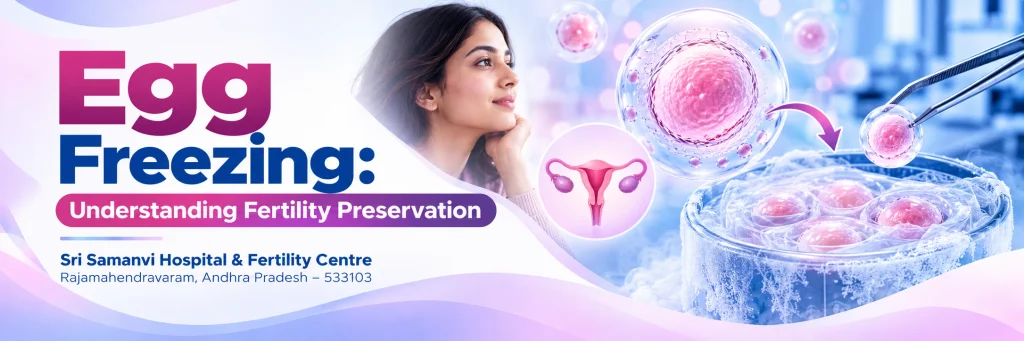
Egg freezing, also known as oocyte cryopreservation, is a fertility preservation technique in which mature eggs are collected from the ovaries and frozen for potential use in the future.
The purpose of egg freezing is to preserve eggs at the age and time when they are available, so they may potentially be used later for fertility treatment. Egg freezing does not guarantee a future pregnancy or baby, but it can be an option for people who want to preserve the possibility of using their own eggs in the future. ReproductiveFacts
Why Do Women Consider Egg Freezing?
There can be different personal, medical and reproductive reasons for considering egg freezing.
1. Planning for Future Parenthood
Some women may wish to delay pregnancy because of personal, educational, career, relationship or other life circumstances.
Egg freezing can provide an option to preserve eggs for possible future use. Cambridge University Hospitals
2. Medical Treatment That May Affect Fertility
Certain medical treatments, including some cancer treatments, can affect ovarian function and future fertility.
When medically appropriate and when there is enough time before treatment begins, egg freezing may be considered as part of fertility preservation. UCL Hospitals
3. Conditions That May Affect Ovarian Function
Certain medical or genetic conditions may increase the risk of reduced ovarian function or premature loss of fertility.
A fertility specialist can assess whether fertility preservation may be appropriate.
4. Preserving Reproductive Options
Egg freezing can allow a woman to preserve mature eggs without requiring a male partner at the time of freezing.
When the eggs are later used, they can be thawed and fertilized as part of assisted reproductive treatment. Reproductive Facts
How Does Egg Freezing Work?
The egg-freezing process is similar to the initial stages of an IVF cycle.
The major steps generally include:
Step 1: Fertility Evaluation
Before egg freezing, the fertility specialist evaluates your reproductive health.
Depending on your individual situation, evaluation may include:
- Medical and reproductive history
- Ultrasound examination
- Ovarian reserve assessment
- Hormonal tests
- Other investigations when clinically required
The evaluation helps the fertility team understand ovarian response and plan the treatment.
Step 2: Ovarian Stimulation
Fertility medications are used to stimulate the ovaries so that multiple follicles can develop during one treatment cycle.
During this period, the ovaries are monitored using ultrasound scans and, when required, blood tests.
The stimulation period commonly involves daily medication for around 10–12 days, although the exact duration varies depending on the treatment plan. ReproductiveFacts
Step 3: Monitoring the Ovaries
Regular monitoring helps the fertility specialist assess:
- Follicle growth
- Development of eggs
- Ovarian response to medication
- Appropriate timing for egg retrieval
The medication protocol may be adjusted depending on the response.
Step 4: Egg Retrieval
When the eggs are considered ready, an egg retrieval procedure is performed.
A fine needle is guided through the vagina to the ovaries, and eggs are collected from the developing follicles.
The procedure is generally performed with appropriate pain relief or sedation/anaesthesia depending on the clinical setting. Egg retrieval is usually a short outpatient procedure. ReproductiveFacts
Step 5: Egg Assessment
After retrieval, the eggs are examined by an embryologist.
Not every egg collected will necessarily be mature.
Only suitable mature eggs are selected for freezing. Kingston and Richmond NHS Trust
Step 6: Egg Freezing
Modern egg freezing commonly uses a rapid freezing technique called vitrification.
Vitrification freezes the mature eggs very rapidly to minimize the formation of ice crystals that could damage the egg.
The frozen eggs are then stored under controlled laboratory conditions for potential future use. Cambridge University Hospitals
What Happens When You Want to Use Frozen Eggs?
When you decide to use your frozen eggs in the future, the eggs are carefully thawed.
The thawed eggs can then be fertilized with sperm in the laboratory.
ICSI (Intracytoplasmic Sperm Injection) is commonly used with previously frozen eggs because a single sperm is directly injected into the egg.
If fertilization occurs and an embryo develops appropriately, the embryo may subsequently be considered for transfer into the uterus. Cambridge University Hospitals
Does Egg Freezing Guarantee a Future Baby?
No. Egg freezing does not guarantee pregnancy or a future baby.
Several factors influence the outcome, including:
- Age when the eggs were frozen
- Number of mature eggs stored
- Egg quality
- Survival of eggs after thawing
- Fertilization
- Embryo development
- Uterine and reproductive factors
- Overall individual circumstances
ASRM notes that the likelihood of future success is influenced by the age at which eggs are frozen and the number of eggs available. ReproductiveFacts
For this reason, egg freezing should be understood as a fertility preservation option, rather than a guarantee of future pregnancy.
At What Age Should Egg Freezing Be Considered?
There is no single age that is appropriate for everyone.
However, egg age matters because both the number and quality of eggs generally decline with increasing age. The decline becomes more noticeable during the later reproductive years. ReproductiveFacts
For someone considering elective egg freezing, an early consultation with a fertility specialist can help assess:
- Current ovarian reserve
- Reproductive goals
- Age-related fertility factors
- Expected response to ovarian stimulation
- Number of eggs that may be appropriate to aim for
The decision should be individualized rather than based on a single age cutoff.
How Many Eggs Should Be Frozen?
There is no universal number of eggs that guarantees a future pregnancy.
The number of eggs that can be collected varies from person to person.
It depends on factors such as:
- Age
- Ovarian reserve
- Response to stimulation
- Number of follicles
- Egg maturity
Some women may require more than one stimulation and retrieval cycle depending on their fertility goals and clinical circumstances.
Your fertility specialist can discuss the expected number of eggs and whether additional cycles may be considered.
Egg Freezing vs Embryo Freezing
Egg freezing and embryo freezing are two different fertility preservation options.
| Egg Freezing | Embryo Freezing |
|---|---|
| Mature unfertilized eggs are frozen | Fertilized eggs that have developed into embryos are frozen |
| A male partner is not required at the time of freezing | Sperm is required to create the embryos |
| Eggs are fertilized when they are used later | Embryos are already created before freezing |
| Provides flexibility regarding future fertilization | Embryo creation has already taken place |
The most appropriate option depends on individual circumstances, reproductive plans and medical considerations.
Egg Freezing for Cancer Patients
Some cancer treatments, including certain chemotherapy and radiation treatments, can affect ovarian function.
When fertility preservation is medically appropriate, egg freezing may be considered before treatment begins.
Because cancer treatment may need to start quickly, fertility preservation discussions should take place as early as possible when appropriate. UCL Hospitals
The fertility specialist and oncology team can work together to determine whether egg freezing is suitable and whether treatment can be completed safely within the available timeframe.
What Are the Possible Risks of Egg Freezing?
Egg freezing involves ovarian stimulation and egg retrieval, so it has potential risks and limitations.
These may include:
- Side effects from fertility medications
- Abdominal bloating or discomfort
- Ovarian Hyperstimulation Syndrome (OHSS)
- Discomfort associated with egg retrieval
- Bleeding or infection related to the procedure
- Not all retrieved eggs being mature
- Not every frozen egg surviving the thawing process
- Not every thawed egg fertilizing
- Not every embryo developing normally
Your fertility specialist should explain the potential benefits, risks and alternatives before treatment.
Does Freezing Eggs Affect Egg Quality?
Egg freezing is designed to preserve the eggs at the time they are collected.
However, freezing does not stop the natural aging process of the woman.
This means that if eggs are frozen at a younger age and used later, the eggs themselves retain the biological characteristics they had when they were frozen. However, pregnancy still depends on many other factors.
Egg freezing therefore provides an opportunity for fertility preservation, but it does not eliminate age-related reproductive considerations altogether.
How Long Can Frozen Eggs Be Stored?
Eggs can be stored for extended periods under appropriate cryopreservation conditions.
The permitted storage period and regulations can vary depending on the country, clinic policies and applicable laws.
Your fertility centre should explain the applicable storage period, consent requirements and future-use procedures before freezing.
Is Egg Freezing Painful?
The experience varies between individuals.
During ovarian stimulation, injections may cause temporary discomfort.
Egg retrieval may cause some discomfort or cramping, but appropriate medication or sedation is generally used to make the procedure more comfortable.
Your fertility team will explain what to expect before the procedure.
Is Egg Freezing Right for Everyone?
Not necessarily.
The decision to freeze eggs should be based on an individual fertility assessment.
A fertility specialist may consider:
- Age
- Ovarian reserve
- Medical history
- Reproductive plans
- Previous surgeries or treatments
- Medical conditions
- Reason for fertility preservation
- Expected ovarian response
A consultation can help you understand whether egg freezing is an appropriate option for your situation.
Egg Freezing at Sri Samanvi Hospital & Fertility Centre
At Sri Samanvi Hospital & Fertility Centre, Rajamahendravaram, fertility care focuses on understanding each patient’s individual reproductive needs.
Under the guidance of:
Dr. Sowjanya M.
M.S. (OBGY), Fellowship in Reproductive Medicine, FMAS
and
Dr. B.M. Rayudu
M.D. (Radiodiagnosis)
the fertility team can evaluate reproductive health and discuss appropriate fertility preservation options.
Depending on individual circumstances, fertility care may include:
- Fertility evaluation
- Ovarian reserve assessment
- Egg freezing
- Sperm freezing
- Embryo freezing
- IVF
- ICSI
- Fertility preservation counselling
- Other assisted reproductive treatment options
The goal is to help patients understand their reproductive options and make informed decisions about their fertility journey.
Frequently Asked Questions About Egg Freezing
1. What is egg freezing?
Egg freezing is a fertility preservation procedure in which mature eggs are collected from the ovaries and frozen for potential future use.
2. Why do women freeze their eggs?
Women may consider egg freezing for personal or medical reasons, including delaying pregnancy or preserving fertility before treatments that may affect ovarian function.
3. Does egg freezing guarantee pregnancy?
No. Egg freezing does not guarantee a future pregnancy or baby.
4. Is egg freezing the same as IVF?
No. Egg freezing preserves unfertilized eggs. IVF involves fertilizing eggs with sperm and developing embryos in the laboratory.
5. Can frozen eggs be used for IVF later?
Yes. Frozen eggs can be thawed and used in assisted reproductive treatment. ICSI is commonly used to fertilize thawed eggs.
6. Can I freeze my eggs without a male partner?
Yes. Egg freezing preserves unfertilized eggs, so a male partner is not required at the time of egg freezing.
7. How many eggs should I freeze?
There is no single number that guarantees future pregnancy. The recommended number depends on factors such as age, ovarian reserve and fertility goals.
8. Does age matter when freezing eggs?
Yes. Egg quantity and quality generally decline with age, so age at the time of egg freezing is an important consideration.
9. Can cancer patients freeze their eggs?
In appropriate cases, egg freezing may be considered before cancer treatment that could affect fertility. Early discussion with the fertility and oncology teams is important.
10. Are frozen eggs safe?
Egg freezing using modern cryopreservation techniques is an established fertility preservation method. However, there are still limitations and no fertility treatment can guarantee a future pregnancy.
Take the Next Step Towards Your Parenthood Journey
If you are considering delaying pregnancy or want to explore fertility preservation, a consultation with a fertility specialist can help you understand your options.
Sri Samanvi Hospital & Fertility Centre
Gandhipuram, Rajamahendravaram, Andhra Pradesh – 533103
Call for Consultation:
0883 2474 242 | 9347531268