Sri Samanvi Hospital & Fertility Centre
Gandhipuram, Rajamahendravaram, Andhra Pradesh – 533103
Meet Our Fertility Specialists
Dr. Sowjanya M.
M.S. (OBGY), Fellowship in Reproductive Medicine, FMAS
Dr. B.M. Rayudu
M.D. (Radiodiagnosis)
Donor Programme in Fertility Treatment
For some couples, pregnancy may not be possible using their own eggs or sperm because of certain medical or reproductive factors. In such situations, a donor programme may be considered as part of assisted reproductive treatment.
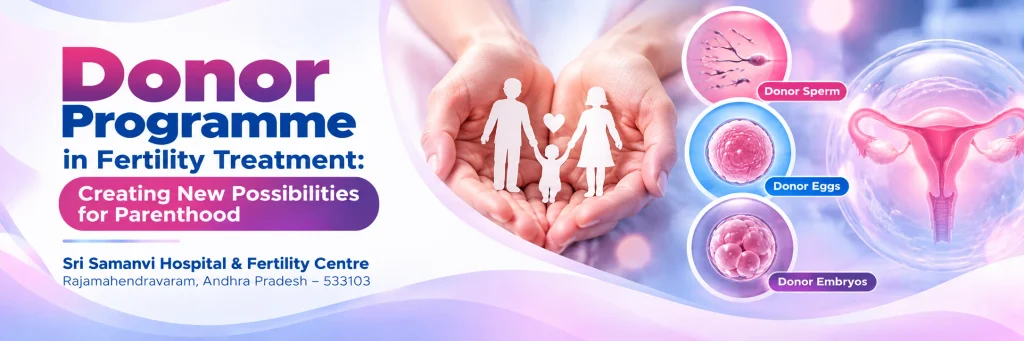
Donor-assisted fertility treatment may involve donor sperm, donor eggs or, in selected situations, donor embryos. The appropriate option depends on the couple’s medical history, fertility evaluation and individual circumstances.
At Sri Samanvi Hospital & Fertility Centre, Rajamahendravaram, donor-assisted treatment is approached with medical evaluation, appropriate counselling and careful consideration of the couple’s individual needs.
What Is a Donor Programme?
A donor programme involves the use of reproductive material from a suitable donor to help achieve pregnancy.
The main types include:
- Donor Sperm Programme
- Donor Egg Programme
- Donor Embryo Programme
The treatment may involve procedures such as IUI or IVF, depending on the type of donor material being used and the medical circumstances.
1. Donor Sperm Programme
Donor sperm may be considered when sperm from the male partner is unavailable or when certain male-factor fertility conditions make the use of donor sperm an option.
It may be discussed in situations such as:
- Severe sperm-production problems
- Certain genetic concerns
- Repeated fertility treatment difficulties related to sperm factors
- Absence of usable sperm in selected circumstances
- When the couple chooses donor sperm after appropriate counselling
Donor sperm may be used with IUI or, when clinically appropriate, as part of IVF treatment.
2. Donor Egg Programme
A donor egg programme involves using an egg from a suitable donor for fertility treatment.
It may be considered in situations such as:
- Very low ovarian reserve
- Premature loss of ovarian function
- Certain genetic conditions
- Significant reduction in egg quality
- Previous IVF cycles where egg-related factors have been identified
- Situations where the patient’s own eggs may not be suitable for treatment
In donor egg treatment, the donor’s egg is fertilized with sperm, usually through IVF or ICSI depending on the clinical situation. The resulting embryo may then be transferred to the recipient’s uterus.
3. Donor Embryo Programme
A donor embryo programme involves the use of an embryo created using donated reproductive material.
This may be considered in selected circumstances when using the couple’s own eggs and sperm is not appropriate or possible.
The embryo is transferred into the recipient’s uterus following appropriate preparation and medical evaluation.
Who May Consider Donor Treatment?
Donor-assisted fertility treatment is not suitable or necessary for every couple.
A fertility specialist may discuss this option after evaluating factors such as:
- Age
- Ovarian reserve
- Egg quality
- Sperm quality
- Previous fertility treatments
- Genetic or inherited conditions
- Reproductive history
- Overall medical condition
- Previous pregnancy outcomes
The decision is individualized and should be made after proper medical and counselling support.
How Does a Donor Egg Treatment Work?
A typical donor egg treatment pathway may involve several stages.
Step 1: Fertility Evaluation
The recipient undergoes an appropriate medical and reproductive assessment.
The doctor may evaluate:
- Uterus
- Endometrial lining
- Hormonal factors
- General reproductive health
- Previous fertility history
Step 2: Donor Selection
A suitable donor is selected according to applicable regulations, screening requirements and fertility-centre protocols.
Step 3: Donor Screening
Donors undergo appropriate medical screening before reproductive material is used.
Screening may include assessment for relevant infectious diseases, medical conditions and other factors required under applicable guidelines.
Step 4: Preparing the Recipient
The recipient’s uterine lining is prepared to provide suitable conditions for embryo transfer.
Step 5: Fertilization
The donor egg may be fertilized with the intended father’s sperm using an appropriate IVF laboratory technique, including ICSI when indicated.
Step 6: Embryo Development
The fertilized egg is monitored as it develops into an embryo.
Step 7: Embryo Transfer
A suitable embryo may be transferred into the recipient’s uterus.
Step 8: Pregnancy Testing
A pregnancy test is performed after the appropriate interval following embryo transfer.
How Does Donor Sperm Treatment Work?
Depending on the situation, donor sperm may be used through IUI or IVF.
With IUI
The prepared donor sperm is placed directly into the uterus around the time of ovulation.
With IVF
The donor sperm may be used to fertilize an egg in the laboratory, followed by embryo development and transfer.
The fertility specialist decides which approach is appropriate based on the woman’s age, reproductive health, fertility history and other factors.
Donor Programme vs IVF Using Own Eggs and Sperm
| IVF Using Own Gametes | Donor Programme |
|---|---|
| Uses the couple’s own eggs and sperm | Uses donor sperm, donor eggs or donor embryos |
| Fertilization takes place using the couple’s reproductive material | Donor reproductive material is involved |
| May be suitable when both partners have usable reproductive material | May be considered when one or both partners cannot use their own reproductive material |
| Treatment is planned according to the couple’s fertility findings | Treatment also involves donor screening and applicable regulations |
Is Donor Treatment Safe?
Donor-assisted fertility treatment involves medical procedures similar to other fertility treatments, depending on whether IUI or IVF is used.
Donor screening is an important part of the process. Appropriate screening and laboratory procedures are used to reduce potential risks associated with infectious diseases and certain medical or genetic conditions.
However, no fertility treatment can completely eliminate every possible medical risk.
Your fertility specialist can explain the specific risks and considerations applicable to your treatment.
Is Counselling Important in Donor Treatment?
Yes.
Choosing donor-assisted treatment can involve medical, emotional and family considerations. Counselling can help couples understand:
- The treatment process
- Donor involvement
- Available treatment options
- Emotional considerations
- Future family considerations
- Questions related to disclosure and communication
- Applicable legal and regulatory requirements
The couple should have an opportunity to understand the treatment before making a decision.
Are Donors Medically Screened?
Yes. Donor reproductive material should undergo appropriate screening according to applicable medical standards and regulations.
Screening can involve:
- Medical history
- Relevant infectious disease testing
- Reproductive health assessment
- Appropriate genetic or other screening where indicated
The exact screening requirements may vary depending on the type of donation and applicable regulations.
Does Donor Treatment Guarantee Pregnancy?
No.
Donor treatment can provide an option for couples who may not be able to use their own reproductive material, but pregnancy is not guaranteed.
Treatment outcomes can depend on factors such as:
- Recipient’s age
- Uterine health
- Embryo quality
- Endometrial preparation
- Medical conditions
- Treatment protocol
- Other individual factors
Your fertility specialist can discuss the factors that may influence your individual treatment.
Donor Egg Treatment and Age
One of the reasons donor eggs may be considered is the effect of age on egg quantity and quality.
As a woman gets older, both the number and quality of eggs generally decline. In some situations, donor eggs may therefore be discussed as an alternative when the patient’s own eggs are unlikely to provide a reasonable treatment option.
The decision should always be based on an individualized medical evaluation rather than age alone.
Can Donor Treatment Be Used With ICSI?
Yes.
When donor eggs are used, ICSI (Intracytoplasmic Sperm Injection) may be considered depending on the sperm characteristics and clinical circumstances.
With ICSI, a single sperm is injected directly into a mature egg in the laboratory to assist fertilization.
The fertility specialist and embryology team determine whether conventional IVF or ICSI is more appropriate.
Important Things to Understand Before Donor Treatment
Before starting a donor programme, couples should understand:
Medical Considerations
The fertility specialist will assess whether donor treatment is medically appropriate.
Donor Screening
Donor reproductive material is subject to appropriate screening requirements.
Legal and Regulatory Considerations
Donor-assisted reproduction is subject to applicable laws, regulations and clinical guidelines. These requirements may change, so the fertility centre should explain the rules applicable to the proposed treatment.
Emotional Considerations
Some couples may need time to discuss how donor conception fits into their family-building plans.
Informed Decision-Making
The couple should receive appropriate information and counselling before proceeding.
When Should You Talk to a Fertility Specialist?
You may consider consulting a fertility specialist if:
- You have been trying to conceive without success.
- Previous fertility treatments have not worked.
- There is severe male-factor infertility.
- Ovarian reserve is significantly reduced.
- There is premature ovarian insufficiency.
- There is a known genetic concern.
- Previous IVF treatment has been unsuccessful because of egg or sperm-related factors.
- You have questions about donor-assisted fertility treatment.
A fertility specialist can first evaluate your situation and then explain whether donor treatment is an appropriate option.
Donor Programme at Sri Samanvi Hospital & Fertility Centre
At Sri Samanvi Hospital & Fertility Centre, Rajamahendravaram, donor-assisted fertility treatment is approached with careful medical evaluation and individualized counselling.
Our fertility specialists can help couples understand:
- Whether donor treatment may be appropriate
- Donor sperm and donor egg options
- Required fertility investigations
- IVF/ICSI treatment options
- Embryo transfer
- Medical considerations
- Counselling and applicable regulatory requirements
Our Fertility Specialists
Dr. Sowjanya M.
M.S. (OBGY), Fellowship in Reproductive Medicine, FMAS
Dr. B.M. Rayudu
M.D. (Radiodiagnosis)
Frequently Asked Questions
1. What is a donor programme?
A donor programme involves using donated sperm, eggs or embryos as part of fertility treatment when appropriate.
2. Who may need donor eggs?
Donor eggs may be considered for women with significantly reduced ovarian reserve, premature ovarian insufficiency, certain genetic conditions or situations where previous treatment suggests that using their own eggs may not be appropriate.
3. When is donor sperm considered?
Donor sperm may be discussed in selected cases of severe male-factor infertility, absence of usable sperm, certain genetic concerns or other specific circumstances.
4. Can donor sperm be used for IUI?
Yes. Donor sperm may be used with IUI when the fertility specialist considers IUI appropriate.
5. Can donor eggs be used with ICSI?
Yes. Donor eggs may be fertilized using ICSI when clinically indicated.
6. Does donor treatment guarantee a baby?
No. Donor treatment can provide another pathway to pregnancy, but it does not guarantee pregnancy or a live birth.
7. Are donors screened?
Appropriate donor screening is performed according to applicable medical standards, regulations and fertility-centre protocols.
8. Is counselling required?
Counselling can be an important part of donor-assisted treatment because the decision can involve medical, emotional, family and legal considerations.
9. Can donor treatment be used after failed IVF?
In selected cases, donor treatment may be discussed after previous IVF attempts, particularly when egg or sperm-related factors have been identified.
10. Is donor treatment suitable for everyone?
No. The suitability of donor treatment depends on the couple’s medical history, fertility evaluation, reproductive goals and applicable regulations.
Take the Next Step Toward Parenthood
If you are considering donor-assisted fertility treatment, a detailed consultation can help you understand your options and make an informed decision based on your individual circumstances.
Sri Samanvi Hospital & Fertility Centre
Gandhipuram, Rajamahendravaram, Andhra Pradesh – 533103
Call for Consultation:
0883 2474 242 | 9347531268