
Sri Samanvi Hospital & Fertility Centre
Gandhipuram, Rajamahendravaram, Andhra Pradesh – 533103
Meet Our Fertility Specialists
Dr. Sowjanya M.
M.S. (OBGY), Fellowship in Reproductive Medicine, FMAS
Dr. B.M. Rayudu
M.D. (Radiodiagnosis)
What Is IVF?
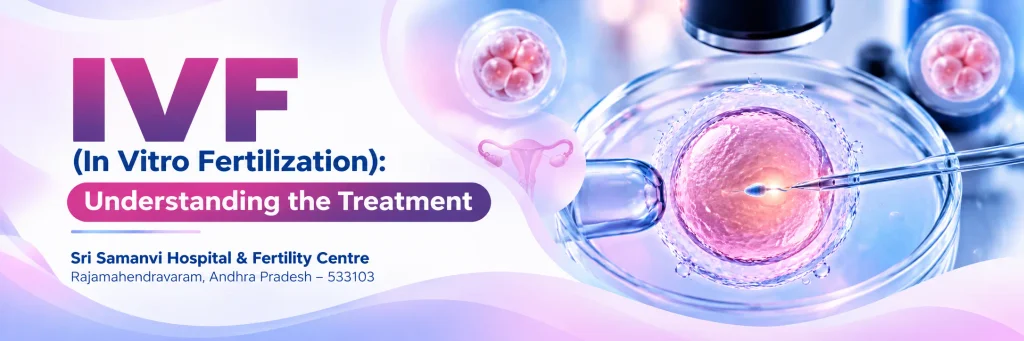
IVF (In Vitro Fertilization) is an assisted reproductive technology in which eggs and sperm are combined in a laboratory to help achieve fertilization. When fertilization occurs, the resulting embryo can be transferred into the uterus. nhs.uk
The term “in vitro” means that fertilization takes place outside the body, in a specialized laboratory environment.
IVF may be considered for different causes of infertility, including certain cases of female infertility, male-factor infertility, blocked or damaged fallopian tubes, endometriosis and unexplained infertility. Reproductive Facts
How Does IVF Treatment Work?
An IVF cycle generally involves several important stages. The exact treatment plan and duration can vary from person to person.
1. Fertility Evaluation
Before beginning IVF, the fertility specialist evaluates both partners.
Depending on the individual’s medical history, this may include:
- Medical and fertility history
- Hormonal tests
- Ultrasound examination
- Ovarian reserve assessment
- Semen analysis
- Evaluation of the uterus and reproductive organs
- Other tests when clinically required
This evaluation helps the fertility team understand the possible cause of infertility and plan the appropriate treatment.
2. Ovarian Stimulation
Normally, the ovaries develop and release an egg during a menstrual cycle.
During IVF, fertility medicines may be used to stimulate the ovaries so that multiple eggs can develop during one treatment cycle. The response to the medicines is monitored through ultrasound scans and, when required, blood tests. nhs.uk
3. Egg Retrieval
When the eggs are considered ready for collection, an egg retrieval procedure is performed.
A specialized needle is guided through the vagina toward the ovaries to collect the eggs from the developing follicles. The procedure is generally performed with appropriate medication for comfort. nhs.uk
The collected eggs are then transferred to the fertility laboratory for evaluation.
4. Sperm Collection
A sperm sample is collected from the male partner.
The laboratory team prepares the sperm sample for fertilization.
In selected situations, when sperm cannot be obtained normally, specialized sperm-retrieval techniques may be considered.
5. Fertilization
The collected eggs and prepared sperm are combined in the laboratory.
Depending on the individual circumstances, fertilization may be performed using:
Conventional IVF
The eggs and sperm are placed together in a laboratory dish and fertilization occurs without directly injecting sperm into the egg.
ICSI
Intracytoplasmic Sperm Injection (ICSI) involves injecting a single selected sperm directly into a mature egg.
ICSI may be considered particularly in certain cases of male-factor infertility or previous fertilization problems. Reproductive Facts
6. Embryo Development
After fertilization, the fertilized eggs are monitored in the laboratory as they develop.
The fertility laboratory team observes the embryos and assesses their development before deciding on the appropriate next step.
Not every egg will fertilize and not every fertilized egg will necessarily develop into an embryo suitable for transfer.
7. Embryo Transfer
An embryo selected for transfer is placed into the uterus using a thin catheter.
The procedure is generally performed through the vagina and cervix without the need for a surgical incision. nhs.uk
After embryo transfer, the patient follows the medications and instructions provided by the fertility team.
8. Pregnancy Test
Following embryo transfer, the fertility team will advise when to take a pregnancy test.
The timing may vary depending on the treatment plan and type of embryo transfer.
If the test is positive, further monitoring and an ultrasound scan may be planned to confirm the pregnancy and assess its early development.
Who May Consider IVF?
IVF may be considered for different fertility conditions.
It may be an option in cases such as:
- Blocked or damaged fallopian tubes
- Certain types of male infertility
- Endometriosis
- Ovulation-related fertility problems
- Unexplained infertility
- Previous fertility treatments that have not resulted in pregnancy
- Certain cases where other fertility treatments may not be suitable
- Situations requiring donor eggs or sperm, depending on individual circumstances
The suitability of IVF depends on the couple’s fertility evaluation, medical history and reproductive factors. Reproductive Facts
IVF for Male Infertility
Infertility can involve male as well as female factors.
Male-factor infertility may be associated with problems involving:
- Sperm count
- Sperm movement
- Sperm morphology
- Sperm production
- Sperm delivery
Depending on the situation, IVF with or without ICSI may be considered.
A semen analysis and appropriate evaluation can help the fertility specialist understand the male fertility factors before treatment.
IVF for Female Infertility
Female fertility can be affected by several factors, including:
- Problems with ovulation
- Reduced ovarian reserve
- Blocked or damaged fallopian tubes
- Endometriosis
- Certain uterine conditions
- Age-related changes in fertility
IVF can bypass the fallopian tubes because fertilization takes place in the laboratory and the embryo is subsequently transferred into the uterus.
IVF for Unexplained Infertility
Sometimes fertility tests do not identify a clear reason why pregnancy has not occurred.
This is commonly referred to as unexplained infertility.
Depending on factors such as age, fertility history and previous treatments, IVF may be one of the treatment options discussed with the couple. Reproductive Facts
IVF vs IUI
IVF and IUI are different fertility treatments.
| IUI | IVF |
|---|---|
| Prepared sperm is placed inside the uterus | Eggs and sperm are handled in the laboratory |
| Fertilization generally occurs inside the body | Fertilization occurs outside the body |
| Less invasive treatment | More complex treatment process |
| Does not involve egg retrieval | Involves egg retrieval |
| May be considered for selected fertility conditions | May be considered for a wider range of fertility conditions |
The appropriate treatment depends on the cause of infertility and the individual’s fertility assessment.
IVF vs ICSI
IVF is the overall assisted reproduction treatment in which eggs and sperm are combined in the laboratory.
ICSI is a specialized fertilization technique that can be performed during IVF, where a single sperm is injected directly into a mature egg.
ICSI may be considered when there are certain sperm-related factors or previous fertilization difficulties. Reproductive Facts
Does IVF Guarantee Pregnancy?
No. IVF does not guarantee pregnancy or a successful live birth.
The outcome of IVF can depend on several factors, including:
- Age
- Cause of infertility
- Egg-related factors
- Sperm-related factors
- Embryo development
- Uterine and reproductive factors
- Overall health and individual circumstances
A fertility specialist can explain the expected treatment outcomes based on the individual’s clinical situation. nhs.uk
What Are the Possible Risks of IVF?
IVF is generally considered a well-established fertility treatment, but like any medical treatment, it has potential risks and limitations.
Possible risks can include:
- Side effects from fertility medicines
- Ovarian Hyperstimulation Syndrome (OHSS)
- Multiple pregnancy
- Ectopic pregnancy
- Discomfort or complications associated with egg retrieval
- Emotional stress associated with fertility treatment
Serious complications are uncommon, but the fertility team should discuss the potential risks and benefits before treatment begins. Reproductive Facts
How Long Does an IVF Cycle Take?
The exact duration of an IVF cycle varies depending on the treatment protocol.
A typical IVF cycle may take several weeks, including ovarian stimulation, monitoring, egg retrieval, fertilization, embryo development and embryo transfer. nhs.uk
Your fertility specialist will provide a treatment schedule based on your individual plan.
Can Embryos Be Frozen?
Yes.
If suitable embryos remain after an embryo transfer, they may be cryopreserved (frozen) for possible future use, depending on the treatment plan and applicable medical requirements. Reproductive Facts
Frozen embryo transfer can allow a future treatment attempt without necessarily repeating ovarian stimulation and egg retrieval.
What Happens After Embryo Transfer?
After embryo transfer, the fertility team may prescribe medications and provide instructions regarding the next steps.
You will be given a suitable date for pregnancy testing.
If pregnancy is confirmed, further follow-up may include an ultrasound scan and continued pregnancy care.
If the result is negative, your fertility specialist can discuss the possible next steps based on your treatment history.
IVF Treatment at Sri Samanvi Hospital & Fertility Centre
At Sri Samanvi Hospital & Fertility Centre, Rajamahendravaram, fertility treatment begins with a detailed understanding of each couple’s fertility needs.
Under the guidance of:
Dr. Sowjanya M.
M.S. (OBGY), Fellowship in Reproductive Medicine, FMAS
and
Dr. B.M. Rayudu
M.D. (Radiodiagnosis)
the fertility team focuses on evaluating possible causes of infertility and discussing appropriate treatment options.
Depending on the individual case, treatment options may include:
- Fertility evaluation
- Ovulation-related treatments
- IUI
- IVF
- ICSI
- Embryo transfer
- Fertility preservation
- Other fertility-care options when clinically appropriate
Every fertility journey is different. A personalized treatment plan can help couples understand their available options and the next steps.
Frequently Asked Questions About IVF
1. What does IVF stand for?
IVF stands for In Vitro Fertilization. It is a fertility treatment in which eggs and sperm are combined in a laboratory to help achieve fertilization.
2. Is IVF painful?
Some parts of IVF, such as injections and egg retrieval, may cause discomfort. Your fertility team will explain the procedures and the available methods for managing discomfort.
3. Who can undergo IVF?
IVF may be considered for people experiencing different types of infertility. Suitability depends on individual factors, fertility history and medical evaluation.
4. Is IVF suitable for male infertility?
Yes. IVF may be considered when male-factor infertility contributes to difficulty conceiving. In some cases, ICSI may also be used.
5. Can IVF help with blocked fallopian tubes?
IVF can be an option for certain patients with blocked or damaged fallopian tubes because fertilization takes place outside the body and the embryo is transferred into the uterus.
6. What is the difference between IVF and IUI?
IUI places prepared sperm into the uterus, while IVF involves collecting eggs, fertilizing them in the laboratory and transferring an embryo into the uterus.
7. What is the difference between IVF and ICSI?
IVF is the overall treatment process, while ICSI is a specialized fertilization technique that can be used during IVF.
8. Does IVF guarantee a baby?
No. IVF can help with fertilization and embryo transfer, but it cannot guarantee pregnancy or a successful live birth.
9. Can IVF be used for unexplained infertility?
Yes. IVF may be considered in selected cases of unexplained infertility depending on the couple’s age, fertility history and previous treatment.
10. Can embryos be frozen after IVF?
Suitable embryos may be frozen for future use, depending on the clinical situation and treatment plan.
Take the Next Step Towards Your Parenthood Journey
If you have been trying to conceive and are considering fertility treatment, a consultation with a fertility specialist can help you understand the possible causes of infertility and available treatment options.
Sri Samanvi Hospital & Fertility Centre
Gandhipuram, Rajamahendravaram, Andhra Pradesh – 533103
Call for Consultation:
0883 2474 242 | 9347531268